
Key Takeaways
Rental property ROI in Hampton Roads depends on far more than monthly rent. Vacancy, property taxes, insurance, maintenance, financing, management, and major repairs can significantly change what an owner actually earns.
Hampton Roads multifamily conditions remained relatively stable at the end of 2025. Virginia REALTORS® reported a 5.7% vacancy rate and average effective rent of $1,515 per unit in Q4 2025. These figures are regional multifamily benchmarks, not expected rents for individual single-family homes.
Property taxes vary considerably among Virginia Beach, Chesapeake, Suffolk, Hampton, Newport News, Norfolk, and Portsmouth, making city-specific expenses an important part of any ROI calculation.
Financing remained a major consideration in 2025 because conventional mortgage rates stayed above 6% throughout the year. Investment-property financing can be priced differently, so owners should calculate returns using an actual investor loan quote.
There is no single "good Hampton Roads ROI" that applies to every rental. Owners should evaluate gross yield, net operating income, cap rate, cash flow, cash-on-cash return, reserves, and long-term equity together.
Rental property in Hampton Roads can provide ongoing income, long-term equity growth, and exposure to one of Virginia's largest regional housing markets. However, the return on a rental property is rarely as simple as subtracting the mortgage payment from the monthly rent.
For owners in Virginia Beach, Chesapeake, Norfolk, Portsmouth, Suffolk, Hampton, Newport News, and surrounding Coastal Virginia communities, the better question is not simply, "How much can this property rent for?" It is, "How much income will remain after realistic ownership expenses are considered?"
That distinction was particularly important in 2025. Hampton Roads continued to see relatively resilient housing and rental demand, but acquisition prices remained substantial, mortgage rates stayed elevated compared with the low-rate years earlier in the decade, and expenses such as property taxes, insurance, maintenance, and flood-related considerations varied substantially from property to property.
Understanding rental property ROI requires looking at the complete financial picture.
What Does Rental Property ROI Actually Measure?
Return on investment, commonly called ROI, describes how effectively a rental property produces a financial return relative to the money invested in it. There is no single formula that tells landlords everything they need to know. Several measurements should be reviewed together.
Gross Rental Yield
Gross rental yield is a simple starting point:
Annual scheduled rent ÷ property value × 100 = gross rental yield
For example, consider a property valued at $300,000 that rents for $2,200 per month.
Annual scheduled rent would be:
$2,200 × 12 = $26,400
The gross rental yield would therefore be:
$26,400 ÷ $300,000 = 8.8%
An 8.8% gross yield does not mean the owner is earning an 8.8% profit. The calculation does not include vacancy, taxes, insurance, repairs, management, association expenses, utilities, or financing. That is why gross yield should be viewed as a screening tool rather than a complete ROI calculation.
Net Operating Income
Net operating income, or NOI, gives landlords a clearer picture. NOI generally represents rental income after normal operating expenses but before mortgage payments, income taxes, depreciation, and major capital expenditures.
Depending on the property, operating expenses can include:
Vacancy and unpaid rent
Real estate taxes
Landlord insurance
Property management
Routine repairs and maintenance
Landscaping or pest control when owner-paid
HOA or condominium expenses
Owner-paid utilities
Licensing or administrative expenses when applicable
Owners should use actual or well-supported estimates whenever possible.
Capitalization Rate
The capitalization rate, commonly called the cap rate, compares NOI with the property's value or acquisition price.
NOI ÷ property value = cap rate
Cap rate is particularly useful when comparing properties because it measures operating performance before considering how an individual owner chooses to finance the investment.
Cash-on-Cash Return
Cash-on-cash return focuses on the cash an owner actually invested.
Annual pre-tax cash flow ÷ total cash invested × 100 = cash-on-cash return
This can include the down payment, closing costs, initial improvements, and other cash required to acquire and prepare the property. Two owners purchasing the same home can therefore have very different cash-on-cash returns if one pays cash and another uses financing.
What Did the Hampton Roads Rental Market Look Like in 2025?
Hampton Roads is a regional market, but it should not be treated as one uniform rental market. A rental in Virginia Beach may perform differently from one in Portsmouth. A Chesapeake townhouse may have a different expense profile than a Norfolk condominium or a single-family property in Suffolk.
One useful regional benchmark comes from the Virginia REALTORS® Q4 2025 Multifamily Market Report. At the end of 2025, the Hampton Roads multifamily market had approximately 182,659 units, an average 5.7% vacancy rate, and an average effective rent of $1,515 per unit. Average effective rent was approximately $60 higher per unit than one year earlier.
Those numbers provide valuable regional context, but landlords should use them carefully. They describe the overall multifamily market and should not be treated as recommended rent for an individually owned house, townhouse, duplex, or condominium. A property-specific rental analysis should consider location, bedrooms, bathrooms, condition, parking, lot size, amenities, recent competing rentals, lease terms, and other relevant features.
Regional Economic Demand Matters Too
Rental demand does not exist independently from the local economy. Old Dominion University's 2025 State of the Region: Hampton Roads identifies defense, the Port of Virginia, and tourism as major economic pillars for Hampton Roads. The region also includes significant activity connected with shipbuilding, healthcare, higher education, government, and other industries.
A diversified base of renters can support long-term housing demand, but regional economic strength does not guarantee that every rental property will remain continuously occupied. Landlords still need to evaluate demand at the neighborhood and property level.
_1.png)
Property Values Affect ROI Just as Much as Rent
Strong rent does not automatically create strong ROI if the acquisition price is also high. According to the Real Estate Information Network's December 2025 Hampton Roads market report, the regional median sale price for homes sold during December 2025 was $360,000, up 1.4% from $355,000 in December 2024. Active residential inventory was also 11.25% higher year over year.
For existing landlords, higher home values can contribute to equity growth. For new investors, however, a higher purchase price can make it more difficult for achievable rent to produce strong immediate cash flow.
Imagine two similar homes that both rent for $2,200 per month.If one costs $250,000 and another costs $375,000, their gross yields are dramatically different even though their monthly rents are identical. This is why rental analysis should begin before purchase rather than after closing.
Property Taxes Can Change the Math Between Hampton Roads Cities
Real estate taxes are one of the clearest examples of why landlords should calculate ROI locally. The City of Chesapeake's official FY2025 Local Tax Comparisons reported the following citywide or comparative real estate tax rates per $100 of assessed value:
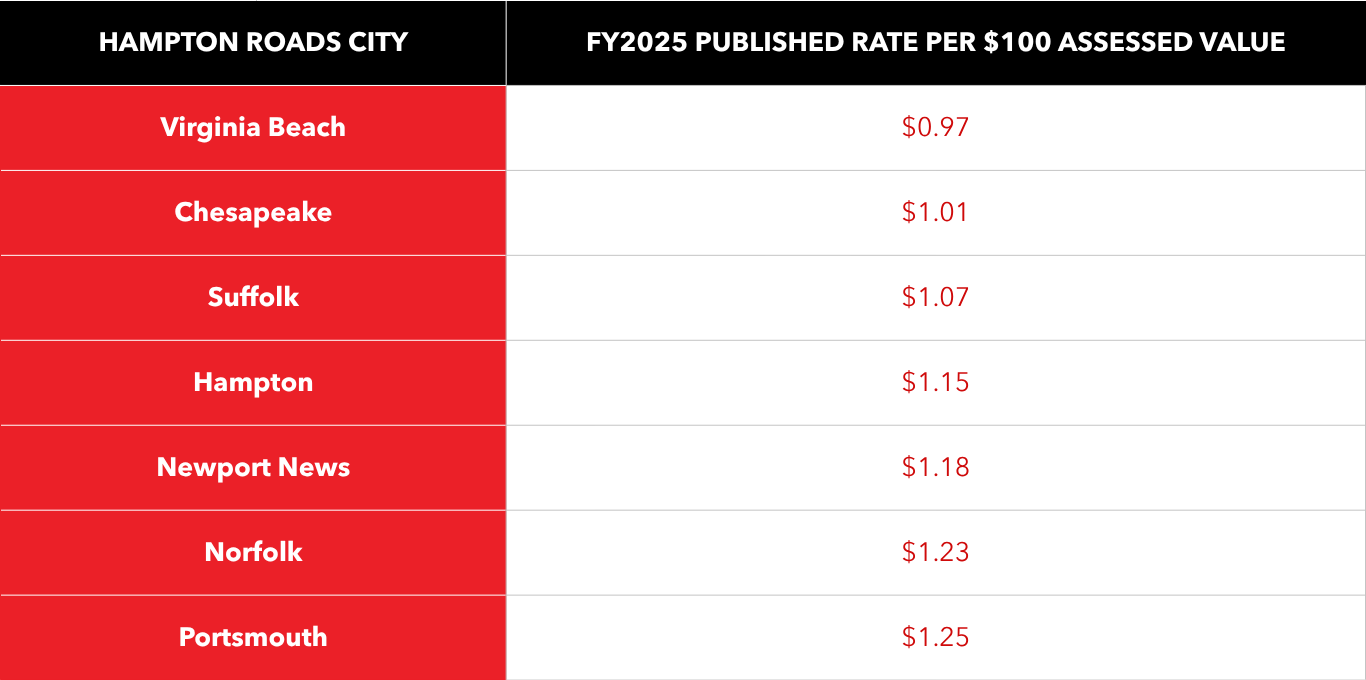
The report notes special circumstances for certain jurisdictions, including district differences in Chesapeake and a one-time tax credit associated with Portsmouth. Owners should therefore verify the actual tax treatment of a specific parcel rather than relying solely on a regional comparison table.
The impact on ROI can be meaningful. A difference of $0.20 per $100 of assessed value equals approximately $700 annually on a $350,000 assessment, before considering any applicable credits, exemptions, districts, or other adjustments. That is nearly $60 per month in additional operating cost. For a landlord operating on a narrow monthly margin, those differences matter.
Vacancy Must Be Included in a Realistic ROI Calculation
One of the easiest ways to overestimate rental ROI is to assume that twelve months of rent will be collected every year.
Vacancy occurs for many reasons:
Normal tenant turnover
Cleaning and property preparation
Maintenance between occupants
Marketing and leasing time
Pricing above what the market supports
Application processing
Unexpected tenant circumstances
The 5.7% Q4 2025 Hampton Roads multifamily vacancy figure is a regional benchmark, not a required vacancy assumption for every rental. Still, it illustrates why assuming zero vacancy indefinitely is unrealistic.
Consider a property renting for $2,200 per month. Losing one full month of rent reduces scheduled annual rental income by $2,200, or roughly 8.3%. Owners should build some vacancy and credit-loss assumption into long-term projections, even when a property currently has a reliable tenant.
Insurance and Flood Exposure Matter in Coastal Virginia
Insurance is another expense that can materially affect Hampton Roads rental ROI. The Virginia State Corporation Commission's Homeowners Insurance Guide explains that homeowners insurance policies issued in Virginia generally do not cover damage caused by floods, surface water, or storm surge. Landlord and investment-property policies differ from standard owner-occupied homeowners policies, so rental owners should discuss the appropriate policy and coverage with a licensed insurance professional.
Flood exposure deserves separate attention. Virginia's Department of Conservation and Recreation provides the Virginia Flood Risk Information System, which gives property owners access to flood-risk information from FEMA and other sources. Federal flood-insurance requirements can also affect financing. The National Flood Insurance Program states that flood insurance is required when a qualifying property is in a Special Flood Hazard Area and has a government-backed mortgage. Even when coverage is not required by a lender, owners should evaluate flood exposure and available insurance options.
Actual insurance premiums should be obtained before purchasing a rental whenever possible. Property location, construction, roof condition, replacement cost, deductible choices, flood exposure, claims history, and other underwriting factors can influence the cost.
.png)
Maintenance and Capital Expenses Should Be Treated Differently
Maintenance is unavoidable, but not every expense occurs on the same schedule.Routine maintenance may include HVAC service, minor plumbing repairs, electrical work, landscaping, appliance repairs, pest treatment, and small exterior repairs. Capital expenditures are typically larger and less frequent.
Examples include:
Roof replacement
HVAC replacement
Water heater replacement
Major plumbing repairs
Significant electrical work
Window replacement
Exterior siding
Major appliance replacement
Crawlspace or moisture remediation
A rental might generate positive cash flow for several years and then require a major system replacement. That does not automatically mean it is a poor investment. It means the owner needs reserves. This is especially important when evaluating older Hampton Roads housing stock. A property with an attractive purchase price may produce a strong gross yield but require more maintenance or near-term capital improvements than a newer property.
A Realistic Sample Hampton Roads ROI Calculation
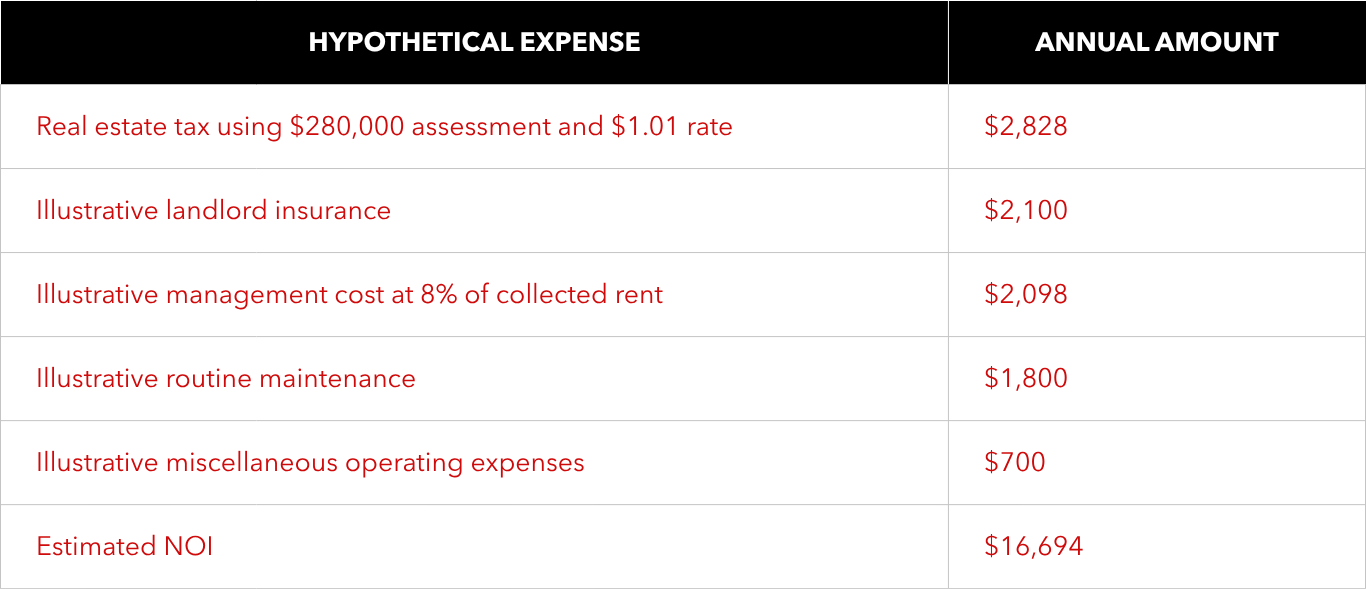
Consider a hypothetical Chesapeake rental purchased for $280,000 and rented for $2,300 per month. This example is provided only to demonstrate the calculation. The insurance, management, maintenance, vacancy, and miscellaneous expense assumptions below are hypothetical and are not Hampton Roads market averages or guaranteed costs.
Step 1: Calculate Scheduled Rent
$2,300 × 12 = $27,600
Scheduled annual rent is $27,600.
Step 2: Account for Vacancy
Assume a hypothetical 5% vacancy allowance:
$27,600 × 5% = $1,380
Estimated effective rental income:
$27,600 - $1,380 = $26,220
Step 3: Estimate Operating Expenses
Step 4: Calculate Cap Rate
$16,694 ÷ $280,000 = approximately 5.96%
The property's gross rental yield was approximately 9.9%, but its hypothetical cap rate after the selected operating assumptions is closer to 6%. That gap demonstrates why gross rent alone can make a property look more profitable than it actually is. The calculation also does not include mortgage payments, income taxes, depreciation, or a dedicated reserve for future capital improvements.
Financing Was a Major ROI Factor in 2025
Financing had a substantial effect on rental acquisitions in 2025.According to Freddie Mac's 2025 Mortgage Market Survey Archive, its benchmark 30-year fixed mortgage rate remained above 6% throughout the year.
However, landlords should not use the Freddie Mac rate directly as an investment-property financing assumption. Freddie Mac's Primary Mortgage Market Survey is a broad conventional mortgage-market benchmark. Investment-property loans can involve different rates, fees, down payments, underwriting standards, and qualification requirements.
Owners should therefore use an actual investor loan quote when calculating cash flow and cash-on-cash return. Higher financing costs can substantially reduce monthly cash flow even when the underlying property's NOI remains attractive.
Virginia Landlord Compliance Can Protect ROI
Compliance is also part of financial performance. A profitable rental can become significantly less profitable when the owner has poor documentation, improper charges, preventable disputes, or incorrect security-deposit procedures.
Under Virginia Code § 55.1-1226, a residential security deposit generally cannot exceed two months' periodic rent.
The statute generally requires the landlord to provide an itemized security-deposit disposition within 45 days after termination of the tenancy or the date the tenant vacates, whichever occurs last. If qualifying damages exceed the deposit and require a third-party contractor, the statute provides a limited additional 15-day period when the required notice is given.
Virginia also changed its rental fee-disclosure requirements in 2025. For rental agreements entered into, extended, or renewed on or after July 1, 2025, Virginia Code § 55.1-1204.1 requires specified charges to be itemized beginning on the first page of the written rental agreement. These include the security deposit, rent due per payment period, and specified additional one-time charges due before the rental begins or included in the first rental payment. Landlords should use current Virginia-compliant leasing procedures and seek legal advice when questions arise about a specific situation.
Tax Treatment Can Affect an Owner's Overall Return
Monthly cash flow is not the only financial component of rental ownership. The IRS explains in Publication 527, Residential Rental Property that qualifying rental-property owners may deduct various rental expenses and generally depreciate eligible residential rental property according to federal tax rules.
Tax treatment depends on the individual owner's circumstances, including basis, property use, ownership structure, income, participation, improvements, and other factors. Tax deductions should not be treated as guaranteed dollar-for-dollar savings. A qualified tax professional can help an owner evaluate the property's actual tax consequences.
How Hampton Roads Landlords Can Improve Rental ROI
Increasing ROI does not always mean increasing rent.
Price the Rental According to the Market
Overpricing can create vacancy that costs more than a modest rent increase would generate. Owners should compare similar properties, recent rental activity, condition, bedrooms, bathrooms, parking, amenities, location, and lease terms before establishing rent.
Reduce Unnecessary Turnover Time
Every vacant day has a cost. Coordinating inspections, maintenance, cleaning, marketing, and leasing efficiently can help shorten preventable downtime between occupants.
Prioritize Preventive Maintenance
Small problems can become expensive repairs when ignored. Routine attention to HVAC systems, roofing, plumbing, drainage, moisture, exterior components, and other major systems can help protect the property and reduce unexpected expenses.
Maintain Adequate Reserves
Monthly cash flow should not automatically be treated as money available to spend. Owners should keep funds available for deductibles, repairs, vacancy, appliance replacement, and major building systems.
Review Insurance Periodically
Coverage and premiums can change. Landlords should periodically review coverage limits, deductibles, exclusions, flood exposure, and replacement-cost assumptions with their insurance professional.
Track Property-Level Performance
Keep income and expenses organized by property. Accurate records make it easier to calculate NOI, identify increasing expenses, evaluate maintenance patterns, prepare tax information, and determine whether the investment is meeting expectations.
What Should Hampton Roads Rental Owners Realistically Expect?
There is no responsible universal statement such as, "Hampton Roads rental properties produce an 8% ROI." Returns vary too much. A lower-cost property may produce strong gross yield but require more repairs. A newer home may cost more to purchase but have fewer immediate maintenance needs. A condominium may shift some exterior responsibilities to an association but add recurring association fees. A property near the water may command different rent while also presenting different insurance and flood considerations.
Owners who purchased years ago may also have completely different returns from investors purchasing similar homes in 2025. An existing owner may have a much lower purchase basis, more accumulated equity, or favorable financing from an earlier interest-rate environment. A new investor must analyze the property using today's acquisition cost and financing terms.
A strong rental investment should therefore be judged on the combination of:
Sustainable market rent
Acquisition price
Vacancy
Property taxes
Insurance
Maintenance
Capital reserves
Management costs
Financing
Long-term property condition
Equity growth potential
The goal is not simply to maximize one percentage. It is to own a financially sustainable property whose income, expenses, risks, and long-term potential make sense together.
Final Takeaway
Rental property in Hampton Roads can be a valuable long-term investment, but landlords should approach ROI with realistic expectations. The 2025 market provided evidence of continued regional rental demand and relatively stable multifamily conditions, while Hampton Roads home values remained substantial. At the same time, higher borrowing costs, city-specific property taxes, insurance expenses, flood exposure, repairs, vacancy, and acquisition prices all affected what owners actually kept.
The most useful ROI analysis is therefore property-specific. Start with realistic market rent. Include vacancy. Calculate taxes using the actual jurisdiction and assessment. Obtain real insurance and financing quotes. Budget for routine maintenance and larger capital replacements. Then evaluate NOI, cap rate, cash flow, and cash-on-cash return rather than relying on rent alone.
A rental that looks highly profitable based on gross monthly income can look very different after all expenses are included. On the other hand, a property with modest immediate cash flow may still contribute to long-term wealth through principal reduction, equity growth, and rental income.
For Hampton Roads landlords, successful rental ownership is less about chasing a single target ROI and more about understanding the entire financial picture, maintaining adequate reserves, and managing the property consistently over time.